Friday, April 17, 2020
Thursday, April 16, 2020
Gris Grimly
Elizabeth recovering from scarlet fever, page 40
"She had, at first, yielded to our entreaties; but when she heard that her favorite was recovering, she could no longer debar herself, and entered her chamber long before the danger of infection was past".
Wow, this is amazing
"It is with considerable difficulty that I remember the original area of my being. I saw, felt, heard, and smelt, at the same time; and it was, indeed, a long time before I learned to distinguish between the operations of my various sense. It was dark when I awoke..." (86)
When I read Frankenstein, this section of the novel was by far my favorite. I loved hearing about the Monster's story of experiencing life and finding the cabin and watching the family. I didnt think it could be done in any other way, but when I read the graphic version of this section, I was astonished by the way Grimly portrayed this section. I absolutely loved the way he made only a few words here and there appear in the text; this was such a beautiful way of showing Frankenstein's growing understanding of language. My question is, if you have read the original novel, what was your favorite translation in the Grimly graphic novel?
Visual Impacts
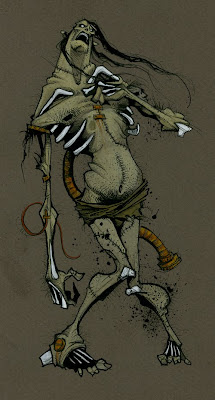
This week's text is a highly new experience for me--both as I am unfamiliar with graphic novels/comics and I have had relevantly little experience with the Frankenstein plot. However, I found the mixed media format of this text highly effective for one main reason: Grimly depicts all characters in an eerily in-human fashion. As a result, I found the lines between those who are "human" and the "creature" blurred.
The Stephen Asma article intrigued me further as he writes, "the uses of monsters vary widely. In our liberal culture, we dramatize the rage of the monstrous creature—and Frankenstein's is a good example—then scold ourselves and our 'intolerant society' for alienating the outcast in the first place. The liberal lesson of monsters is one of tolerance: We must overcome our innate scapegoating, our xenophobic tendencies." (Asma). Again, I personally feel all the characters of Grimly's text have an "other' aspect to them. With all characters resembling something other than what we would typically assign as "human" our mind does not automatically cast the creature as something to be feared due to it's unfamiliar nature. At this point in the text, I have sympathy for the creature and very little for Victor. Combining the ideas of the McCloud theory from last week, I believe Grimly's remix of Shelly's story into a graphic text with visuals makes the overall work more impactful. The reader is challenged to question early on if the creature is, in fact, a "monster."
A Different Type of Reading? Maybe?
After reading some much about comic form last week, I feel like its important to discuss the impact of reading this in comic form. If i'm being completely honest I think I read last weeks book without really interacting that much with the comics. I think because it was a book explaining the use of comics, a lot was said. However with this Frankenstein, which is very creepy, I feel like the comics add more function to the book. I felt like you needed the pictures here, where as the other text it was explaining the pictures. For instance Volume 2 chapter 3 is almost entirely visual. Personally speaking, I found this a bit challenging. In many ways I felt like I was on auto pilot reading portions of this text and then when I got to that portion I really had to stop and think. It truly is a different way of processing information. I feel like it is a different type of reading in a way. I'm not sure If I like it or not yet. I think ultimately I like the blend of words and comics. Only having the pictures is difficult for me.
Also worth mentioning I was familiar with the general plot of Frankenstein, but not overly familiar. I had never read the book. So personally speaking I found the scene where he is forced to recognize his duty as a creator to be very well done here. I think this was a good example of when the use of the comics added to the story telling element of the text. The visuals really hit home emotions with the limited text. So I found that to be a strength of this version of the story. But I have never read the classic text so I do not have much to compare it to.
The Vibe of the Illustrations in this Book Define "Steampunk"
I've noticed that a lot of folks have already commented on the main plot point of this novel that I had been excited to talk about as well--what defines something or someone a monster, where do the lines begin to blur between good versus evil? I think this is excellent and is why in any format, Frankenstein has always been a compelling story. However, to make my post (hopefully) slightly different than others, I'll ask about how the formatting of Gris Grimley's Frankenstein particularly contributed to the story.
This book wasn't a pure definition of comic-book, but also wasn't purely an illustration book either. This remix of Frankenstein added a childlike wonder in the illustrations for me, so I will ask:
Did this remix of Frankenstein make the story more digestible and accessible for younger audiences to enjoy? Was it just the illustrations or something else in the formatting of the story? Do comic books or books with illustrations automatically correlate to being for children in your eyes?
![]() |
| Trying to identify the everyday monsters in 2020 be like |
Increased Creepiness :)
One of the things I most enjoyed about Gris Grimly's Frankenstein is that the illustrations allow the reader to see past Victor Frankenstein's limited perspective. It removes us from the mind of the first person narrator and gives us the chance to look at and assess his story from more of an outsider's point of view while simultaneously reading his take of events. The first moment this stood out to me was the irony on page 40 when Shelley describes baby William as "the most beautiful little fellow in the world" while Grimly gives us a cute but mildly repulsive blob of flesh to represent the character. Another was on page 55 because there was a distinct difference in what the two authors conveyed: Shelley described the extent Frankenstein's obsession had taken over his mind while Grimly gruesomely portrays what that obsession looked like in action. The two components work well together to grant the reader a fuller picture (ha) of the moment. It is certainly a more unique reading experience.
How do the images change the tone of the original text? Is it different than what you expected? How much would the reading experience change if Grimly had approached the project with a different artistic style? (Even his flowers have skulls on them. I love the detail, but it certainly sets the creep-factor in stone.)
Subscribe to:
Posts (Atom)