Showing posts with label Le Morte D' Arthur. Show all posts

Tuesday, February 18, 2020

insert cool title here

While reading this text, I mainly found myself focusing on how it compares to its predecessors, it being one of the first mass-printed texts in England. Something I noticed right off the bat is that it reads far more like a novel we would see today than anything that came before it, in a sense that there appeared to be far more emphasis on dialogue than before. As we discussed last class, Geoffrey of Monmouth's Arthur chose to focus heavily on descriptions of battles and often omitted many details in favor of these descriptions. In Le Morte d'Arthur, we saw a much more even spread.

My question now is, why the sudden focus on dialogue? I don't know exactly how the new technology could have promoted this, but clearly there was a shift. I'm curious to know just why that shift occurred.

not really related in any way except for the words new technology, but I liked it


Assigning Value in Le Morte d'Arthur


In the third excerpt of Le Morte d’Arthur, I noticed a difference between what the Knights of the Round Table valued and what we may value today.  King Arthur and company tend to focus on the big picture while I’m stuck losing the forest for the trees.  Most of the characters involved easily overlook Lancelot and Gwynevere’s transgressions, only to focus their attention on maintaining their group dynamic.  Arthur even goes on to say, “I regret less the loss of my queen … than of our fellowship, which was surely without equal in all Christendom” (502). From a modern perspective, this points to a lack of humanity on the part of all those involved, but perhaps Malory’s contemporary readers were more interested the ideas that Arthur’s Round Table represented than any person-to-person dealings within the story.  This is echoed in the Armstrong article, which includes the argument that women in literature can gain power by being portrayed as helpless victims.  Gwynevere, in this excerpt, is constantly at risk of execution and hardly gets any dialogue, but ultimately, through almost every other character’s indifference, sets into motion the downfall of Arthur’s boys club.

The Plight of the Tragic Hero Lancelot

As we have done a close study of literary archetypes and how the relate to the Hero's Journey, and in turn to pop culture, I find myself examining the role of the perceived supporting character, or "side kick." Frequently the supporting characters of a story line are written in a way to force them into the background, and yet their story is often more intriguing than the "hero."

I personally enjoy Malory's portrayal of the supporting character in Le Morte d'Arthur, as the plot provides space to Lancelot. One of the Round Table's most famous nights, Lancelot is a frustrating character; however, he has more redeeming qualities than Arthur. Lancelot, though, is damned from the begin to fail, despite his best efforts to do what he deems as right.

Support for this claim is provided through Arthur and Lancelot's choices in battle and love. Arthur is consistently guided by Merlin when on the battlefield. Merlin councils Arthur to end the battle with the eleven kings (Malory 1, pg. 16) and again when he fights King Pellinore (Malory 1, pg. 23-24). Lancelot, on-the-other-hand, must make these determinations in battle himself: when challenged by Gawain, he cannot betray his former ally and instructs his men to spare the knight (Malory 3, pg. 505).

Arthur has two romantic relationships outside of Gwyenevere: Sanam and Margawse. In both situations Arthur gives into his temptation and as a result born two sons. Lancelot, is pursued by Elaine, but cannot force himself to marry or allow her to commit adulterous acts. Lancelot's "nobility" is entirely a waste, though: both Elaine and Gawain die as a result of his actions. Nevertheless, I personally find Lancelot's struggles more redeeming. Lancelot acts in the interests of others, despite disastrous outcomes. Arthur continually thinks of himself (murdering all children born on May Day). Yet, Lancelot's greatest flaw is his love of Gwyenevere, while Arthur's most redemptive moment is his reveal of awareness of the love and desire to not punish the lovers. These two character's arches parallel one another and distinctively highlight the theme of destiny. Arthur is fated to succeed and die a hero; Lancelot is slated for tragedy.   

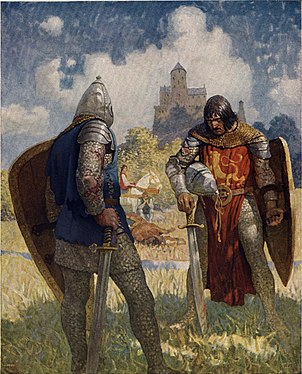
Image result for sir lancelot and arthur
Image sourced: https://en.wikipedia.org/wiki/Lancelot 

Image result for printing press meme
     A key feature of popular culture is. of course, popularity. By definition, this requires that it is widey distributed and engaged with by many people. A.S.G. Edwards states
"He [Caxton] made extensive changes to the manuscript of Malory’s Le Morte Darthur, dividing it into books and chapters and modifying some parts of the text where he felt the language could pose difficulties for his readers."
to what extent does this affect the popular perception of Arthur, as opposed to previous versions? How did the printing press enable the spread of popular culture?

Fantasy and Magic

Malory's piece on King Arthurs allows the reader to explore some key differences between the tale and Geoffrey of Monmouth's piece. Malory's story reads more like a novel. There was a wider range of characters, deeper narratives, and an emphasis on magic and trickery. Geoffrey's piece reminds of a  modern propaganda with a disproportionate emphasis on warfare and religious fervor. The major difference that stood out was the major role that Merlin played in Malory's work in comparison to the minor role that he played in Geoffrey's work. Merlin's character represented a split from a focus on the crusading and religious fervor to a focus on the internal conflict and fantasy. Both narratives posit that War of the Roses and rising problems with the Catholic Church made the common folk look for something that would give them a reprieve from the harsh world they inhibited.

                                   Image source-BBC.UK.com

That's one way to make him less perfect

"On Merlin's advice, in order to destroy his bastard son Mordred, Arthur commanded that, on the pain of death, all babies of the nobility born on May Day were to be brought to the court. Arthur then sent them adrift in an unmanned vessel, which eventually foundered. However, the plan failed, for the wreck was discovered by a yeoman who clambered aboard and found a lone survivor, whom he took into his care; and this was the baby Mordred" (25).
Arthur's not so perfect anymore! Not only is he not strong enough in this version to defeat every opponent he ever encounters, he also listens to his looney prophet/ wizard/ advisor and decides TO HAVE A BUNCH OF INNOCENT BABIES KILLED? And, of course, it's only mentioned briefly in this one paragraph, and then we move on.
Also. What does it say about England's view of fate that both Arthur's birth and Mordred's survival occurred under very specific and unusual circumstances?


Protest: https://www.desicomments.com/user-submitted/stop-killing-babies/

Monday, February 17, 2020

It's not the "who," it's the "why"!


"Who made the changes that cause Caxton’s Morte to diverge from the Winchester manuscript is less important than the fact that the changes are made. Such alterations are more important for what they say about late medieval English literary culture than for what they might tell us about Caxton’s taste in literature, or Malory’s second thoughts on his massive opus."   

This statement really gets to the heart and soul of the study of popular culture.  If we are to believe that art is a mirror of the society that creates and consumes the art, the study must be on the why, not necessarily on the who.  As an example, I do not find the differences in King Arthur as striking from the original text nor as interesting in the Malory version, however, I do find the changes in the cast of supporting characters as the more interesting "why" question.  I am certainly not saying King Arthur is not changed, I just find the changing status of woman and their relationships with men as really striking in the version we studied this week!  Again, it begs the question of "why"?  Although I am just now learning and researching this time period, many of the changes can be contributed to the War of the Roses, changing societal beliefs about the role of woman and men, and (perhaps?) an editor thinking he can make the story a bit better if he "just made these little changes" to circulate even more copies of his printed text.  Wouldn't this last example be a wonderful example of popular culture and myths bending to the will of the people and the consuming society?   

So put me down, punk


Difranco, Ani. "Not A Pretty Girl Live in Cleveland OH," YouTube, uploaded by Righteous Babe Records, 

I'm fascinated by the conversation about gender and power in both Armstrong's article and Le Morte D'arthur. Armstrong contends that by "constructing the feminine as always helpless, needy, and vulnerable, the oath ironically renders women powerful, in that knights are compelled to obey when a lady requests assistance" (141). In this framing, the damsel in distress has power over the knight by virtue of his oath to protect her, an argument that seems akin to ideas about how women, in their sexual objectification by men, hold a kind of sexual power over them. In the sense that the feminine provides the "marginal, yet critical" (142) counterpoint to the "dominant, active, masculine knightly agent" (141), the argument holds in a sort of Taoist, abstract way. But it's also (obviously) deeply problematic to assign "power" to a group that is systemically oppressed and powerless because the group that put them in that position decides to take an oath to protect them. (Note, also, the irony that the knights are usually saving the women from...you guessed it...other knights.) I mean, would we say that babies have power over their parents by virtue of their parents deciding to feed them? Where would they be if we didn't?

What do you get when you combine a biblical story with King Arthur?

Though the first passage was familiar to the previous one we read, it did strike me at the end Arthur's plan to kill his own son was...well...way to friggin' familiar. Though I guess that does help with the propaganda. My question is: Does replacing the tell tale story of Moses from the bible (and various Greek tragedies that the plot bases killing their own son so they won't usurp him) add positively to the propaganda of King Arthur's story of success?

Friday, February 14, 2020

Damn Lancelot :/

"Father, I pray that my sorrow is not displeasing to God. But when I recalled the peerless grace and beauty of the Queen, and the great joy with which we all beheld her and the King at the court, my heart began to fail me. Then, seeing them together in the tomb, I fully understood for the first time how I had betrayed them and brought each ot his death through my selfish love and pride; and so it is I feel that my spirit can no longer sustain my body" (Malory)

I am so frustrated with Lancelot. This moment is the FIRST TIME he noticed that he fucked everything up?? Also, they paint his death like this beautiful thing because he ultimately went to Heaven (?)
, pssht, BS. He literally lied so much about what he and the Queen were doing, and despite the fact that he tried to be honorable throughout this whole story, he and the Queen are still the reasons for all of the death and demise. Arthur died for such a stupid reason. I am so annoyed.