Showing posts with label Quote. Show all posts

Thursday, April 2, 2020

Lydia Bennet: a Whole New Character


Quote: Lydia: Jane and Lizzie are too worried about "propriety" and "letting things take their own time" and "not over-using air quotes" to get anything done at all. 

Question: How did the Lizzie Bennet Dairies change people's perceptions of the original Pride and Prejudice characters? Did you like certain characters more? Less? What changed? 

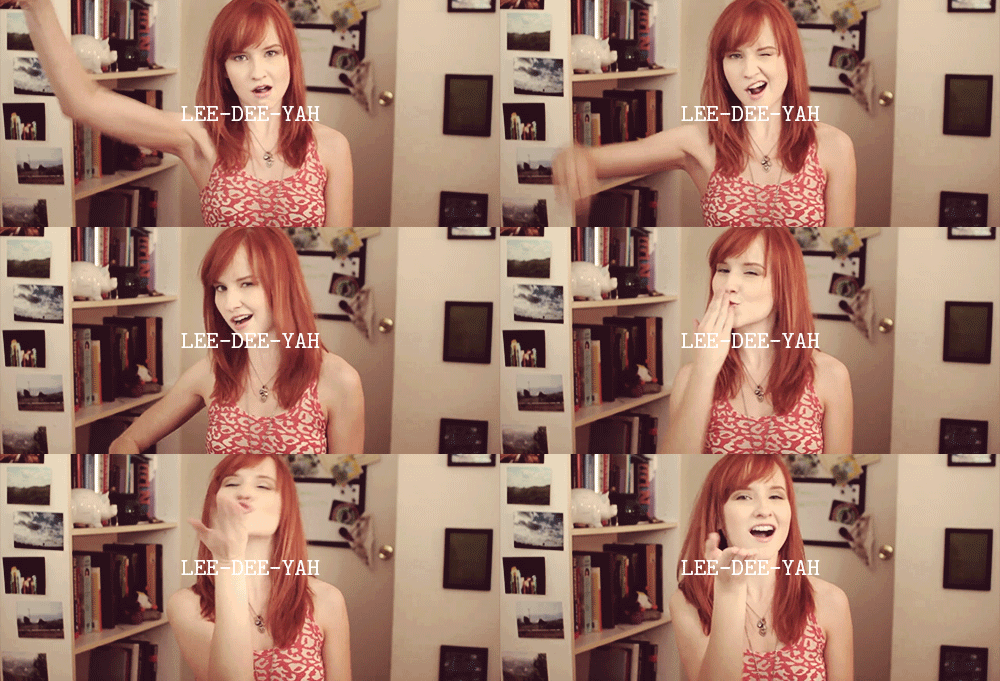
Follow up: Personally TLBD changed how I view Lydia Bennet. In my pervious experience with P&P, I always found her beyond annoying and struggled to find redeemable qualities in her; however, TLBD changed my view. When her character was remixed, I saw how young she is and needing attention not just for the sake of attention but to feel she had value in the Bennet family. Her older sisters are in many ways "perfect" and extremely close with one another. In comparison, Lydia always seems to fall short. One element that is lost is Mrs. Bennet's adoration for her youngest daughter. While you can see hints of it in TLBD (Lydia getting away with almost anything), without Mrs. Bennet actually in the story some of that relationship is lost. 
The Voice of Lydia Bennet - Panel & Frame - Medium

Wednesday, March 25, 2020

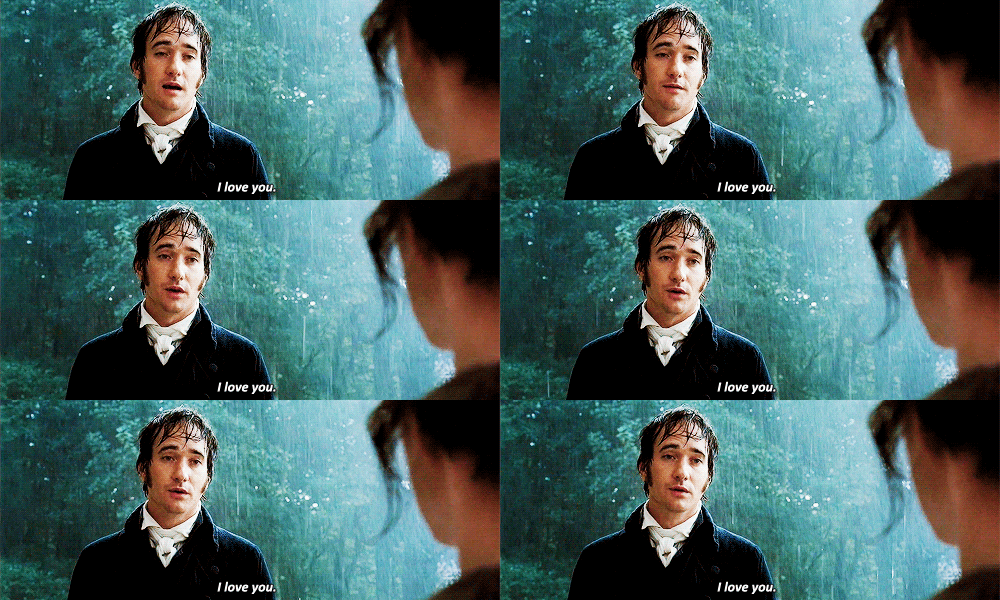
We Stan Men Putting Aside Their Pride!!!!!

"'In vain I have struggled. It will not do. My feelings will not be repressed. You must allow me to tell you how ardently I admire and love you.' Elizabeth's astonishment was beyond expression. She stared, coloured, doubted, and was silent. This he considered sufficient encouragement, and the avowal of all that he felt and had long felt for her, immediately followed. He spoke well, but there were feelings besides those of the heart to be detailed, and he was not more eloquent on the subject of tenderness than of pride. He sensed her inferiority--of its being a degradation--of the family obstacles which judgement had always opposed to inclination, were dwelt on with a warmth which seemed due to the consequence he was wounding, but was very unlikely to recommend his suit." (131)


Mr. Darcy's suddenness here of his first proposal to Elizabeth was a significant point in the novel--for the first time Mr. Darcy is setting aside his pride to admit what he really wants--it's the first sign that he is willing to better himself for her. This act of love shocks Elizabeth, and intrigues her. This is one of the moments that always stands out the most to me--and I'm intrigued, especially by the male members of the class, what everyone thinks of this moment? Was he overstepping? Was it too much? Was this a sign of sincerity or his first sign of maturity? Because for me, this novel was filled with a lot of romantic gestures that made my heart swell, and this was really the first one of them. I love that both Elizabeth and Mr. Darcy bettered themselves for one another!!


Tuesday, March 3, 2020

Baz Luhrmann more like Bad Luhrmann

"Even in the classroom, the dominant definition of the legitimate way of appropriating culture and works of art favours those who have had early access to legitimate culture, in a cultured household, outside of scholastic disciplines, since even within the educational system it devalues scholarly knowledge and interpretation as 'scholastic' or even 'pedantic' in favour of direct experience and simple delight." (499)


This "early access" to legitimate culture, whether at home or in school, that is mentioned in this quote from Pierre Bourdieu reminded me a lot of our class conversation from last week. Today, less and less children are reading Romeo and Juliet seemingly than ever before. If they're exposed to this story at all, it is likely through one of the adaptations produced in the twentieth or twenty-first centuries, whether it be West Side Story or Romeo and Juliet the film, or something of the like. I still find these adaptations to be less enriching of an experience than reading the original play, or seeing a live performance of it. But less enriching doesn't make these films or only seeing this story through the lenses of these films any less "legitimate" or favorable, rather they are just...not as aesthetically good, in my opinion. There were some choices made in both West Side Story and Romeo and Juliet (1996) and phew were they something. But I guess they are not any less legitimate...although we really should continue to challenge our children with what they read.

The Art of Love and Zombies

"A work of art has meaning and interest only for someone who possess the cultural competence...the code into which it is encoded."

My experience with rewatching and finally finishing West Side Story then to jump into Warm Bodies was strange to say the least. The variations of the love of Romeo and Juliet, the remixing of the nurse and the two "houses" at odds with each other, even death is switched up a bit to accommodate to the remixed plot. I find it hilarious that these directors and writers can create the same premise but make it fit into the current times, especially in a zombie apocalypse.

The quote above I disagree with completely. A work of art can have meaning and interest for many people. You can show a random person who isn't fully culturally aware Warm Bodies, they'll still understand that it's clearly a zombie movie that wanted to jump on the zombie hype train of the time but make it a love story. Sure, they won't delve any deeper than that meaning for them but this quote seems to have a narrow view on what makes culture culture.

Monday, February 24, 2020

Remixing Classics Makes them More Accessible

Image result for romeo and juliet meme


"Are the most memorable Shakespeare productions you’ve seen modern or “classical”? Do you find it jarring when Hamlet picks up an iPad? What did you make of Mr. Leveaux’s 'Romeo and Juliet'/" (Isherwood, "To Renovate or Not to Renovate").

"Beyond that, performances must be shaped line by line and scene by scene. Given the remoteness of some of the language, and the sheer complexity of the plays, I would guess that most actors are immensely grateful to directors for helping them shape their performances" (Isherwood, "Updates Work, Except When They Don't")

Is the point of reworking classics to be innovative? To keep the work alive for modern audiences? To allow audiences to understand the plot before cycling back to the original work? All of the above?

I once argued with a classmate on the merit of works like the "Lizzie Bennett Diaries" when taking the Jane Austen course here at Hood. Her point was that the work warped and misconstrued one of Austen's most beloved works; my point, that a side from being entertaining, it is re-telling stories that keeps them alive, in conversation, and in the best case peaks peoples interest in reading the original--while allowing them to understand otherwise complex language they may not have understood previously. Remixes can also highlight points of a work that can otherwise go unnoticed by audiences who have worked with them time and time again. So perhaps as a scholar of Hamlet you uncover a new interpretation when the namesake picks up an iPad as opposed to a skull.


Tuesday, February 11, 2020

Geoffrey of Monmouth has his finger on the pulse...of his patrons?


In "The Conquest of the Past in The History of the Kings of Britain," Michael Faltera critiques Michelle Warren for under underemphasizing "the extent to which patronage shapes ideology" (127). Put perhaps more crudely, his point is that there's a straight line between money and content (something we're all well aware of). This seems to further problematize the idea of truly original content - even people who eschew financial support for their artistic endeavors are doing so in the framework of commodifying artistic expression in general. Is it possible that we occasionally mistake creativity (or originality) for cleverness (being nimble in a specific framework, but still limited in expression)? Or are they the same thing?

Monday, February 3, 2020

Copyright is kind of terrifying


“The ridiculous thing about the situation isn't that Lucas doesn't want to make the cut of the film that I want to watch. It's that it was illegal for Harmy to make it. And it was illegal for me to download it. And it would be illegal for me to make it available for download from Vox.com or even to put a link on this page that would let you go get it. It's illegal because of how Congress has over the years extended and expanded the scope of copyright law in ways that have become perverse and destructive to human culture.


This quote from the Vox article brought me back to the final chapter of the film “Everything is a Remix” and reminded me of a question Dr. MB posed to the class at the end of that day; why do we reward originality? what is so special about originality? Of course, originality exhibits creativity, which is a favorable characteristic, but some things that aren’t considered ‘original’ also display aspects of originality, aka the crowdsourced Star Wars. Because of our copyright laws, we could be stripped of this creativity in any moment, and that is very scary to me.