Showing posts with label 501. Show all posts

Thursday, April 30, 2020

Grimm's Fairytales Reimagined-Female Empowerment

Original Text: Grimm’s Fairy tales

I thought it would be interesting to take the tales of Snow White(Snowdrop), Cinderella, and Sleeping Beauty(Briar Rose) from Grimm’s Fairy tales and recreate them into a video game.  What I have noticed is that many adaptations of these classic tales such as Disney’s versions and some modern versions such as A Cinderella Story(2004), Once Upon a Time(2011-2018), and Snow White and the Huntsman(2012) all possess some of the same elements or what I would call an adapted version of the “hero’s journey” by Joseph Campbell.  Cinderella’s call to adventure comes in the form of wanting to go to the ball/festival and being guided by her fairy godmother or spirit of her dead mother in the original tale.  While with Snow White, it is the threat of her evil stepmother wanting her dead.  In Sleeping Beauty, it is the lure of the evil fairy’s curse that is triggered on her fifteenth birthday.  All these women or girls go through a version of the hero’s journey, but ultimately they do not complete the process.  It takes a man or prince in most of their cases to save them from their fates.  Especially with the me too movement and the overall movement for women’s rights that a video game geared towards women would be a good idea to create a modern adaption of these fairytales.  It seems that a lot of video games out there are geared towards a male dominated audience, I know there are some role playing/interactive apps with a female protagonist. 

Proposed Title: Twisted Fairytales  


Plot Idea:  I have a general idea for the plot.  I want the video game to give back a sense of power and individuality to these princesses by allowing them to go on their own adventures.  Perhaps each character would be playable and their story would have multiple levels to pass before they could “win” or get their happy ending.  In the case of Snow White and Sleeping Beauty, up to the point where they fell under their respective spells should be the backstory.  The game starts when they are asleep; it is in their dreams that they have to work to free themselves from the spell.  The prince could still exist but they might first encounter him in the dream world.  Cinderella could be in an alternative version of her world when the fairy godmother casts her spell.  In all their stories, the wicked stepmothers and fairy are trying to take over the kingdoms.  It is only in defeating them in the dreamworlds that they can be defeated when the spell breaks.        


Image Source: https://www.pinterest.com/pin/373376625353832927/

Final Blog Post: Coming through the Rye

Remix and Crossover by Kelsey Ritner and Payton Mills

Original Texts: Catcher in the Rye by J.D. Salinger, Apocalypse Now (1979) directed by Frances Ford Coppola, and The Heart of Darkness by Joseph Conrad
Remix name: Coming through the Rye
Genre: Movie
Setting: Starts out in approximately 1977 on the Hawaiian islands. Jumps back in time to 1965 and the start of the Vietnam War.

Basic plot overview: Holden Caulfield has been in and out of school since being kicked out of Pencey Prep. He barely graduates high school, but somehow manages, only to flounder through a year of college before dropping out. Since then, he has worked odd jobs and been estranged from his family. After being forced to reunite with them--and face his demons--at his sister Phoebe's wedding, Holden decides it's finally time to change his life. The outbreak of war between the States and Vietnam provides him an easy fix--Holden enlists despite his slightly older age. The "Old Guy" throughout basic training and eventual deployment, Holden is forced to grow up and provide support for the younger men in his company. The story will alternate between the present (1977) where Holden has developed into an alcoholic, his time at war, and flashbacks to Salinger's original story. The intermix of these scenes will highlight how PTSD affected not only Holden, but an entire generation. 
Apocalypse Now (1979) - Rotten TomatoesAmazon.com: The Catcher in the Rye (9787543321724): J.D. Salinger ...

Thursday, April 23, 2020

Us versus the Monsters

“These monsters ask us how we perceive the world, and how we have misrepresented what we have attempted to place.  They ask us to reevaluate our cultural assumptions about race, gender, and sexuality, our perception of difference, our tolerance towards its expression.  They ask us why we have created them.”(Cohen 20)

The creature in Frankenstein asks Victor why he created him.  What was Victor’s purpose in doing so and what message or lesson is this supposed to instill in us as the reader and society? Does the creature serve to remind us that in having these assumptions and intolerance, that it makes us into monsters ourselves?


Image Source: https://www.thoughtco.com/hernan-cortes-conquest-of-aztecs-timeline-2136533

He's Gone Mad

"I know not by what chain of thought the idea presented itself, but it instantly darted into my mind that the murderer had come to mock at my misery, and taunt me with the death of Clerval, as a new incitement for me to comply with his hellish desires. I put my hand before my eyes, and cried out in agony - 'Oh! Take him away! I cannot see him; for God's sake, do not let him enter!'" (153)

This quote was especially important to me and my understanding of the text, as it was the first point in which I actually began to sympathize with Frankenstein and understand the true impact that the creation had on him. For the first half of the text, I really identified with the creature and just kept thinking, "Frankenstein turned him into a monster, he wasn't one to begin with," and while I still believe that to be true, I also now see the mental influence that this creature really had on its creator. The gradual decline to insanity reminded me of Taxi Driver and The Shining - I feel like it's a pretty classic trope that you see in a lot of films and novels (those are just the first ones I thought of at the moment).

My question is, what do you think is more provoking: Frankenstein turning the creature into a monster, or the creature's effect on Frankenstein's mental condition?
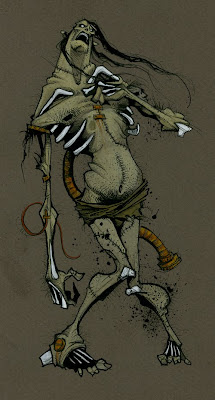
Crazy and Hairy Frankenstein - Taken from Gris Grimly's Blog

Overcome by fear

"When I looked upon him, when I saw the filthy mass that moved and talked, my heart sickened. I tried to stifle these sensations..." (117).

I have personally written and read many comments of others that the creature is someone to pity due to how society treats him based off his appearance; however, I have to question that if, in reality, we would be able to be sympathetic to the creature? I would like to believe that I could see beyond his overpowering, in-human appearance. But sadly, I think that something so out of the norm would be startling and out of uncertainly usually stems fear. I think Grimly's remix makes this story an accessible text to younger audiences due to the pictorial use--not because the pictures inherently make it childish, but the metaphor of the blind man was more easily translated: he is the only one able to "see" the sincerity of the creature because he is not "blinded" by his appearance. So my main question is what examples of the creature exist in our own society? And how do we overcome our misplaced fears to see what is truly in front of us and teach younger generations to not have that fear in the first place? 

Wednesday, April 22, 2020

To Reappear Someplace Else

"We see the damage that the monster wreaks, the material remains, ...but the monster itself turns immaterial and vanishes, to reappear someplace else.... No matter how many times King Arthur killed the ogre of Mount Saint Michael, the monster reappeared in another heroic chronicle, bequeathing the Middle Ages an abundance of morte d'Arthurs" (4).

This quote seems especially relevant for our class.  Through the lens of Grimley's Frankenstein, it's obvious that the creation from Shelly's original has returned in a new form.  We can also point to several film adaptations, cartoon references, and Halloween costumes.  But what about monsters in texts that haven't been remixed?  If we pretend that Shelly's Frankenstein was the first and last appearance of this sort of monster, how can we imagine his return?  Assuming he fulfills his promise to end his life, ould he continue to exist in-universe through Walton's retelling of the tale?  Would he live on through "new" monsters that may have taken some influence from Shelly?

Thursday, April 16, 2020

Visual Impacts

This week's text is a highly new experience for me--both as I am unfamiliar with graphic novels/comics and I have had relevantly little experience with the Frankenstein plot. However, I found the mixed media format of this text highly effective for one main reason: Grimly depicts all characters in an eerily in-human fashion. As a result, I found the lines between those who are "human" and the "creature" blurred.

The Stephen Asma article intrigued me further as he writes, "the uses of monsters vary widely. In our liberal culture, we dramatize the rage of the monstrous creature—and Frankenstein's is a good example—then scold ourselves and our 'intolerant society' for alienating the outcast in the first place. The liberal lesson of monsters is one of tolerance: We must overcome our innate scapegoating, our xenophobic tendencies." (Asma). Again, I personally feel all the characters of Grimly's text have an "other' aspect to them. With all characters resembling something other than what we would typically assign as "human" our mind does not automatically cast the creature as something to be feared due to it's unfamiliar nature. At this point in the text, I have sympathy for the creature and very little for Victor. Combining the ideas of the McCloud theory from last week, I believe Grimly's remix of Shelly's story into a graphic text with visuals makes the overall work more impactful. The reader is challenged to question early on if the creature is, in fact, a "monster." 


Gris Grimly's Frankenstein: DETAILS ARE IN THE DECAYED...

What Constitutes a Monster?

After reading the first hundred pages of Grimley's Frankenstein along with Asma's "Monsters and the Moral Imagination," I couldn't help but ask myself, what exactly characterizes someone as a "monster"?

We see monsters played out millions of ways in film, art, music, and literature, but what exactly is the determining factor in their monstrous label? Asma's retelling of the coffee bar story made me wonder if someone with Silva's mental capacity could be a monster, and in a sense, I guess the term doesn't discriminate. It kind of reminded me of a Law & Order episode where a mentally handicapped man ended up killing numerous people because he was convinced they were all agents for the KGB who were trying to keep him out of the Olympics (he was a roller skater, but that's a longer discussion) so he had to kill them to protect himself. Does that make him a monster?

Honestly, I don't know the answer. Obviously killing someone else is morally wrong, but what if your mind convinces you that there is no other choice and you're doing it for the "greater good," or simply to protect your own life? I think the lines get blurry when your mental capacity is handicapped.

After reading Grimley's Frankenstein, I couldn't help but feel sorry for the "monster" who never asked to be created in the first place. I've never read Shelley's novel before, but I would imagine that the illustrations in Grimley's text make it easier to swallow... Although I think the particular illustrations towards the end of our reading made it even harder for me to see the monster as a true monster, and just made me feel even worse for him.
The Monster, longing for interaction. Picture taken from Pinterest

Wednesday, April 15, 2020

What Makes a Monster

This week's readings of "Monsters and the Moral Imagination" and Grimley's "Frankenstein" really hit home with me.  First before I go into the main topic of my post, I wanted to say that I enjoyed reading this comic version of Frankenstein.  I have always had a hard time reading the original story, I always got dragged down in the language.  The imagery helped to give life to the psychological and moral challenges presented in the story.

In the "Monsters and the Moral Imagination" article, Asma points out that perhaps there has been an increased interest in monsters and mayhem due to turmoil in the society.  Especially as we are going through this COVID-19 crisis,  I wonder if there is going to be even more of an interest in monsters and mayhem.  Asma said, "monsters can stand as symbols of human vulnerability and crisis.  Part of our fascination with serial-killer monsters is that we (and our loved ones) are potentially vulnerable to sadistic violence."  In a crisis such as what has been going on with the virus, people are more prone to become these monsters.  A week and a half ago, a man came driving down my main street that I live on and killed his ex wife and shot one of my neighbor's teenage son dead.  I drove down the road five minutes after this all occurred.  This made me think, what would I have done if I had been directly involved?  Also, what makes someone turn into a sadistic monster?  As I read Frankenstein, I felt sympathy for the creature.  The creature was not given the opportunity to learn right from wrong; it was the job of Victor to give him the foundation for a good life.  Instead Victor spurned the creature leading to both of their downfalls.  Society seems to spurn people that are different and it is society who helps to make the monsters real and imaginary.


Image Source: https://allthatsinteresting.com/serial-killer-quotes

Thursday, April 2, 2020

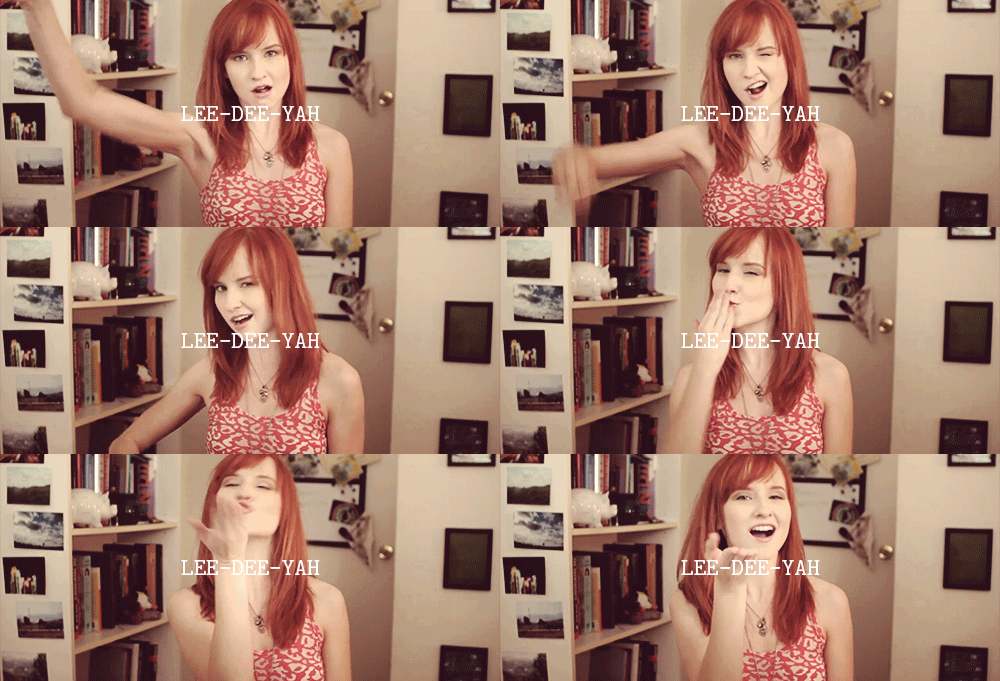
Lydia Bennet: a Whole New Character


Quote: Lydia: Jane and Lizzie are too worried about "propriety" and "letting things take their own time" and "not over-using air quotes" to get anything done at all. 

Question: How did the Lizzie Bennet Dairies change people's perceptions of the original Pride and Prejudice characters? Did you like certain characters more? Less? What changed? 

Follow up: Personally TLBD changed how I view Lydia Bennet. In my pervious experience with P&P, I always found her beyond annoying and struggled to find redeemable qualities in her; however, TLBD changed my view. When her character was remixed, I saw how young she is and needing attention not just for the sake of attention but to feel she had value in the Bennet family. Her older sisters are in many ways "perfect" and extremely close with one another. In comparison, Lydia always seems to fall short. One element that is lost is Mrs. Bennet's adoration for her youngest daughter. While you can see hints of it in TLBD (Lydia getting away with almost anything), without Mrs. Bennet actually in the story some of that relationship is lost. 

The Voice of Lydia Bennet - Panel & Frame - Medium

Darcy in the Lizzie Bennet Diaries

I forget the exact episode of the Lizzie Bennett Diaries that discusses what would presume to be the first instance of Darcy showing interest in Lizzie.  The night of the presumed to be bad dinner party, Lizzie and the gang go out for drinks and arcade games.  From Lizzie's perspective, we learn Darcy was in the corner with Caroline.  From Charlotte and Jane, we learn that Darcy seemed to be focused on Lizzie and did not seem to know how to show his interest in a socially acceptable way.  In the novel, we as the readers do not really see Darcy's interest till he proposes and it seems out of line.  In watching these videos, Darcy comes across as kind of awkward and socially inept, but not necessarily out of line in his behavior.  We see Lizzie's judgment of him first.  My question is, what can we gleam from this series about Darcy and how this speak to the human condition?


Image source: https://www.shmoop.com/study-guides/literature/pride-and-prejudice/fitzwilliam-darcy

To (Let Viewers) See Anything Other than My First Impression

In the 99th episode of The Lizzie Bennet Diaries, Darcy, in discussing his prior views of Jane, tells us, “it just took a while for me to see the similarities; to see anything other than my first impression.”  

Although the character is only speaking from his own point of view, and about one other person specifically, this line could have come from any number of characters in the series.  Lizzie is obviously neither innocent of prejudice in the novel nor the adaptation.  Since much like the novel, the YouTube series is presented from her perspective, her first impressions tend to be our only impressions – especially when it takes considerable time for her to move past them.  Whether holding onto her first impression of Wickham as handsome and personable (although the series does a great job at portraying his low intelligence), or of Darcy as stuck-up and self-centered, Lizzy never allows viewers a new perspective on people.  The rare instances where Charlotte or Jane stand up for an absent character are quickly brought to an end by our protagonist.

Thursday, March 26, 2020

Pride and Prejudice as Reality TV


It looks like I’m not the only first-time reader of Pride and Prejudice here.  Like Mike, I struggled significantly in finishing this book.  Every time I sat down to read, my phone instantly became the most interesting thing in the world comparatively.  How was I supposed to be interested in rich people making the poor decisions only rich people can make?  Why should anyone worry about what Lady Catherine De Bourgh thinks about people? The internet isn’t even around, Elizabeth! It’s not like she can go on a Twitter tirade about how low class you are!

It was only once I got some perspective from my girlfriend that I was able to really appreciate the book.  She told me to think about Pride and Prejudice as if it were reality TV.  Contemporary Austen readers didn’t have 90 Day FiancĂ©, Big Brother, or even The Real-World Road Rules Challenge to keep them occupied.  Characters in Pride and Prejudice are not unlike people on reality TV today.  Mrs. Bennet is flaky and air-headed, Mr. Wickham is a low-life, and Mr. Collins is more full of himself than anyone has any reason to be.  434 pages may be a bit intimidating, but cut this story into 30-minute segments, and most of America will surely tune in.