After reading some of the dialogue on the Original Trilogy fan page I was left feeling rather sympathetic for George Lucas. As viewers, fans and now students we need to consider how this all played out for Lucas. Lucas created Star Wars on a very limited budget hardly expecting it would be the success that it has become. I don't believe even a foolish optimist would have thought Star Wars would have earned 1% of the amount of revenue the franchise has if they were in Lucas's shoes. The fact that it has become as successful as it has is truly remarkable. However with that success, it has elevated Lucas to a position that he probably never dreamed of, and I am not referring to his plethora of money in that regard. To many fans, Lucas has risen to somewhat of a God like "all knowing figure." Some of that may be from comments that Lucas has made and others simply because we want to think there is someone who has the answers to ALL of our questions about this universe he has created. I highly doubt that Lucas thought every word he said would be scrutinized about the minor details and nuances of his universe. Therefore I find it to be a bit unfair to be upset that an interview from 1977 contradicts an interview from 1983 and vice versa. NO ONE would have had all of the ins and outs of Star Wars figured out in that manner. So personally I believe it is okay that some of his details are somewhat problematic.
However, I think we can hold Lucas accountable for his desire to play into this role. At times it appears that he enjoys the role of all knowing figure when he claims to have always had a plan, or known this or that would happen. As the creator, of course he wants to show a persona of being in control of his creation and some arrogance is perhaps warranted. Yet, if he wore to have some humility and admit to not having it all completely known, he might catch less flack from this fan community. Although I doubt it bothers him too much.
Additionally, we should note the idea that Lucas is a revisionist. Revisionism is very prevalent in historical study, partly because I believe it is human nature. We do not want to admit our faults. We do not want to admit our struggles or mistakes. Consequently we alter, change, revise our stories, our histories and so forth. It is clear that Lucas has tried to do that with his original trilogy to attempt to get closer to the perfection model that Star Wars is now held too. I find his attempts to be somewhat reasonable, although I also believe that his fan base would be more considerate of those alternations if he was upfront about his intentions, rather than attempting to hide them or prevent people from seeing them. Admit the changes and move on, rather than hope your fan base is going to be ignorant to your desired changes. All and All I think Lucas is okay and I wouldn't mind if there were more Star Wars movies if he ever gets bored and needs a refresher.
Friday, January 31, 2020
Tuesday, January 28, 2020
The Hero with a Thousand Faces by Joseph Campbell
“Hence the dependent child and its mother constitute for months after the catastrophe of birth as dual unit, not only physically but also psychologically. Any prolonged absence of the parent causes tension in the infant and consequent impulses of aggression ; also when the mother is obliged to hamper the child, agressive responses are aroused. Thus the first object of the child’s hostility is identical with the first object of its love, and its first ideal is that the unity of the Madonna and Bambino.”(6)
As I was reading this passage, I was curious about how this dynamic. How did Luke not having a connection to his biological parents potentially shape his growth and development and put him on a path to being a “hero”? Could Princess Leia be seen as this guiding mother-like figure?
Star Wars: Mentor & Hero
When reading/watching/reviewing the different things for tonight class, what stuck out to me was something said during the 2 minute youtube clip from Bill Moyers' The Power of the Myth. When talking about the point in the movie where Ben Kenobi's voice is in Lukes head saying, "Use the force Luke. Let go. Luke", he says that "this thing communicates. It is in our language that is talking to young people today. And that's marvelous". My first thought: what is "it"? I found this to be very confusing, yet also making a lot of sense. I know that sounds odd; it is something I can understand but I am unsure how to explain why I understand it. I am just lost on what "it" is.

When reading on the "cheat sheet" about the mentor and the hero interactions it states, “The Hero meets a Mentor to gain confidence, insight, advice, training, or magical gifts to overcome the initial fears and face the Threshold of the adventure." This is what happens with Luke and Ben, Ben gives him the lightsaber and helps him to train with it and fight with it. In that Youtube clip it is also said that, the mentors of the heroes often give them some type of instrument or tool to use as well as a psychological center. I interpreted this as the mentor giving the hero a weapon or object in order to complete whatever their journey is, and offering them the tools they need to get past their mental blocks in order to be successful in their journey.

When reading on the "cheat sheet" about the mentor and the hero interactions it states, “The Hero meets a Mentor to gain confidence, insight, advice, training, or magical gifts to overcome the initial fears and face the Threshold of the adventure." This is what happens with Luke and Ben, Ben gives him the lightsaber and helps him to train with it and fight with it. In that Youtube clip it is also said that, the mentors of the heroes often give them some type of instrument or tool to use as well as a psychological center. I interpreted this as the mentor giving the hero a weapon or object in order to complete whatever their journey is, and offering them the tools they need to get past their mental blocks in order to be successful in their journey.
The Enigmatic Journey Within All of Us
Star Wars! And Freud! And Oedipus, oh my! What I really got from "The Monomyth" reading was not the journey of the hero--but rather, what makes that journey possible. With Star Wars, we get the classic hero with Luke Skywalker. He's orphaned from birth, and he then saw the burned bodies of his only other relatives who raised him. He then has a mission, with nothing to lose, because he's never had much. Heroes tend to be born not from upbringings of privilege or excess, but rather they have struggled, continue to struggle, and are able to overcome it through their determination and resilience they have formed from childhood. A quote that particularly stood out to me from this reading was:
Full circle, from the tomb of the womb to the womb of the tomb, we come: an ambiguous, enigmatical incursion into a world of solid matter that is soon to melt from us, like the substance of a dream. And, looking back at what had promised to be our own unique, unpredictable, and dangerous adventure, all we find in the end is such a series of standard metamorphoses as men and women have undergone in every quarter of the world, in all recorded centuries, and under every odd disguise of civilization.
So what is important here, is not only the journey of the individual, but how every individual journey is affected by each other. This article touched a lot on motherhood and how we as humans are more reliant on our mothers from birth than any other mammal. The compassion we have from a loving mother affects us. The loss we have from an absent mother affects us. What we have, what we have lost, and what we have never known through our relationships and intertwining journeys is paramount. The journey of the hero is only possible, not because of the individual themselves, but because of other journeys that preceded them. Our existences are but fleeting, and is both in our control and out of it.
The predestined hero
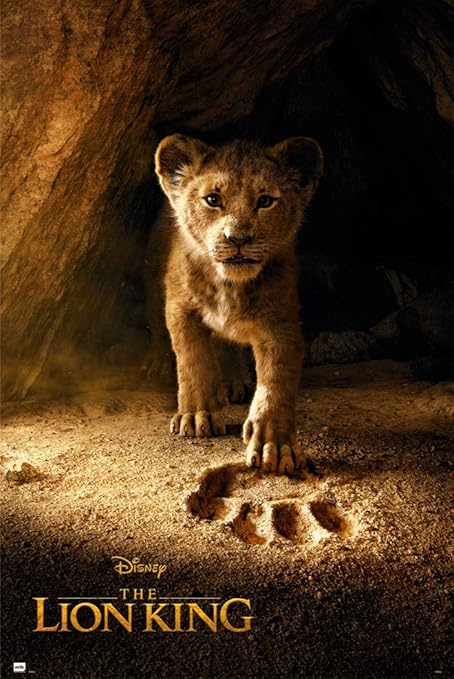
Maybe the answer is obvious to some, but nevertheless I'm curious: why is the archetype of a hero detached from their birth parents continually re-written? Examples frequently appear: Simba (The Lion King), Harry Potter (Harry Potter), Peter Parker (Spiderman)...and of course Luke Skywalker (Star Wars). Upon further reading this quote from Campbell slightly clarifies the point: "...for now it appears that the perilous journey was not a labor of attainment but re attainment, not discovery but rediscovery. The godly powers sought and dangerously won are revealed to have been within the heart of the hero all the time" (39). Still I'm curious what others think in regard to why were drawn to this story-line.

Disney's The Lion King (2019). Image sourced from Amazon.com. Originally distributed by Walt Disney World Pictures, visual effects supervised by Robert Legato, Elliot Newman and Adam Valdez.

Disney's The Lion King (2019). Image sourced from Amazon.com. Originally distributed by Walt Disney World Pictures, visual effects supervised by Robert Legato, Elliot Newman and Adam Valdez.
The Hero's Journey For Normies
The structure and idea of The Hero's Journey, is great for us all to enjoy as we live our normal day to day lives. It gives us an insight on worlds unimaginable, of problems and scenarios only in our dreams that we can experience in a sense. We can't contribute to the story ourselves but it gives us a sense of vacation from the norm. In Star Wars, we are in the distant past in a galaxy not like ours. We follow the story of a young white man and his journey. As a black woman myself I couldn't fully immerse myself but the challenges Luke faces, his mentor and other characters who help and join him along the way we can see through his eyes and ride along with him as we too are experiencing this other world together. Luke's right of passage in a way is also our own that lead into the other movies following. The structure may be reused and done over and over but it has a purpose, and what isn't broken shouldn't need to be fixed, only tweaked.
Homage and Popular Culture
As we discussed last class, it is impossible to be truly original in media these days. I was already aware of the inspirations George Lucas took from Akira Kurosawa while making Star Wars, but I had not realized how many elements, down to individual shots, recreated ones from the various war films and other projects shown in the Everything is a Remix video. So what makes these references homages rather than plagiarism? I would say it is the way they are linked together, combined with the innovative combination of scale models, puppetry, stop=motion animation, rotoscoping and pyrotechnics that gave Star Wars its distinctive feel.
Film has an audio-visual language that a good filmmaker uses to elicit a desired reaction. You don't need to have seen the WWII bomber turret scenes to enjoy the Millennium Falcon/ TIE fighter battle in the first Star Wars movie, but you might actually appreciate it more if you had and could get the reference. This works for the same reason that literary allusions work, and this is the very root of popular culture; expressions and meanings that transcend other boundaries. Even people who have never seen a single moment of Star Wars can tell you that "Luke, I am your father" is a line from Darth Vader (even though that's technically incorrect). The misquote itself is a part of the popular culture that relates to Star Wars.
Subscribe to:
Posts (Atom)