We often Lord Jane Austen as the first main stream female success story in literature. But perhaps due to the time in which she lived it is very hard to examine her as a historical figure. Yes she wrote about the hypocrisy of the era between the rain George the third and the rain of William the fourth, but as the political movements that would inspire women in the world over in the 19th century we’re not at fruition Austin is alone on an island. She died the generation before temperance and abolition came to full force in Britain she did not know of a society where even most men could cast a vote for an election to the house of commons. Perhaps that’s what makes for literature as time tested as it is because she’s holding up a mirror to a society that cannot endure by any means. By the timer for deaf millions of an in franchise man lived in Glasgow EdinburghLiverpool Birmingham Manchester Cardiff Swansee Dublin and Belfast maybe the most important thing we can learn from Austin it’s not so much the difficulty of being a woman before property voting rights for granted to them although that is an important angle we should also consider that Austin is commenting on a society that had no staying power and was desperately in need of reform. I don’t think Austin was a wig or a liberal I do think she understood the society around her. And in that way the way she Challenges early 19th century prescriptions for how to be a woman how to love how to coexist in community and society I think that is her most enduring legacy. She foreshadowed an age she would not live to see one of tremendous industrial and political progress that would see abolition temperance and even universal enfranchisement come to pass she couldn’t see it but I think somewhere deep inside she know it’s coming and I think that is what we can learn from her.
Wednesday, March 25, 2020

what is love?
"No," said Darcy, "I have made no such pretension. I have faults enough, but they are not, I hope, of understanding. My temper I dare not vouch for. It is, I believe, too little yielding--certainly too little for the convenience of the world. I cannot forget the follies and vices of others so soon as I ought, nor their offenses against myself. My feelings are not puffed about with every attempt to move them. My temper would perhaps be called resentful. My good opinion once lost, is lost forever."


(I LOVE Matthew Rhys lol)
I love this quote because it addresses the biggest issue of the novel (obviously) which is misunderstandings. It becomes clear that Darcy had good intentions and Elizabeth misunderstood him greatly. Their relationship is deep because of this. My question is, does it take a rift or misunderstanding for a relationship to be 'valid'? As in, is the impulsive passionate love between Romeo and Juliet just as valid as the long and flourishing love of Elizabeth and Darcy?
The Plight of Pride and Prejudice in Pop-Culture
I am equal parts excited to discuss Pride and Prejudice and completely dreading it. I wouldn't say I idolize Jane Austen; however, I can fully admit she's my favorite writer and at times I can be extremely bias. Now that being said this particular work is my second-to-least favorite Austen text. As a result of this class, I am now being forced to analyse why exactly it comes up short among the six completed novels. I also want to explore why P&P garners the most attention in pop-culture.
To start P&P feels more juvenile than Austen's later work. When comparing P&P to the works Austen wrote after her hiatus the plot is noticeably thinner than say Emma or Persuasion. For example, Austen deals her later heroines harsher consequences and forces them to examine their own personalities and the responsibility they have when making choices. Anne Elliot (Persuasion) rejects Captain Wentworth due to his lack of social status and must live with that choice for six years. After that she must watch as a twenty-six year old--a spinster in the Regency Era--as he peruses different romantic partners before they finally resolve their relationship. In contrast, Lizzie Bennet waits an insignificant amount of time to gain her happy ending after initially rejecting Darcy.
Now my personal issues with Lizzie Bennet. Again my issue becomes one of comparison: when you line up Lizzie with Anne Elliot or Emma Woodhouse she is not nearly as strong or well developed. I have always been fascinated by people's love of Lizzie Bennet- their reasoning being her strong-willed personality. Yes, Lizzie can be strong willed and have a bit of an attitude (in a good way), but the consequences of that attitude are minimal. The greatest tribulation Lizzie must overcome is a lack of dowry and her ridiculous family. Anne Elliot must be alone for six years and Emma Woodhouse is forced to completely take stock of her actions and refine her entire personality, all while thinking she lost the love of her life to one of her closest friend.
With all that being said my main frustration with P&P? It is often times the only work of Austen's that people are familiar. Leading me to ask why? Austen has five other novels that are just as, often times more, entertaining. When I talk with people I am happy to hear they at least know something of Sense and Sensibility, but usually just P&P. Additionally, most people are only familiar with the 2007 Keira Knightley adaption or the Colin Firth BBC mini-series; and not the novel.
One possible conclusion: it's the first published work. Doesn't seem to be enough, though. The multiple adaptations and re-mixes of P&P are definitely a leading factor. Why is this the most appealing Austen work to adapt to film or re-mix? I personally believe it comes back to our instinctual love of fairy-tales; and P&P has all the elements of a Cinderella story. In fact, as an undergrad I wrote an entire paper charting the characters of P&P with their Cinderella archetype. Quick summary: Lizzie = Cinderella, Mrs. Bennet/Catherine de Bourgh = evil step-mother, Ugly Step-Sisters = Lydia and Kitty/Caroline Bingley, Fairy God Mother = Mrs. Gardiner, etc. You get the point, we love the familiar (as we have all learned in this class, nothing groundbreaking) and I personally feel much of P&P is familiar to our childhood stories.
All that being said? I still love P&P. It is still one of my favorite novels. Why I personally love the novel is different than other peoples. My favorite characters? Mrs. Bennet and Charlotte Lucas. Mrs. Bennet while annoying and ridiculous faces a difficult reality: five daughters who cannot inherit and so must marry to survive. She is smart enough, and loves her daughters enough, to know if they remain unmarried after their father's death the world will be a cold place for them. Charlotte Lucas faces a similar reality as Lizzie, but doesn't exactly get her happy ending. She is realistic, though, making the best of the situation she is in and marries Mr. Collins not out of weakness but strength, knowing it is her way to get by.
Alright rant over. I can't wait to read others thoughts. And please, if you haven't already, read some of Austen's other work. Emma is my personal favorite, Mansfield Park is my least (I do not recommend reading it next).
To start P&P feels more juvenile than Austen's later work. When comparing P&P to the works Austen wrote after her hiatus the plot is noticeably thinner than say Emma or Persuasion. For example, Austen deals her later heroines harsher consequences and forces them to examine their own personalities and the responsibility they have when making choices. Anne Elliot (Persuasion) rejects Captain Wentworth due to his lack of social status and must live with that choice for six years. After that she must watch as a twenty-six year old--a spinster in the Regency Era--as he peruses different romantic partners before they finally resolve their relationship. In contrast, Lizzie Bennet waits an insignificant amount of time to gain her happy ending after initially rejecting Darcy.
Now my personal issues with Lizzie Bennet. Again my issue becomes one of comparison: when you line up Lizzie with Anne Elliot or Emma Woodhouse she is not nearly as strong or well developed. I have always been fascinated by people's love of Lizzie Bennet- their reasoning being her strong-willed personality. Yes, Lizzie can be strong willed and have a bit of an attitude (in a good way), but the consequences of that attitude are minimal. The greatest tribulation Lizzie must overcome is a lack of dowry and her ridiculous family. Anne Elliot must be alone for six years and Emma Woodhouse is forced to completely take stock of her actions and refine her entire personality, all while thinking she lost the love of her life to one of her closest friend.
With all that being said my main frustration with P&P? It is often times the only work of Austen's that people are familiar. Leading me to ask why? Austen has five other novels that are just as, often times more, entertaining. When I talk with people I am happy to hear they at least know something of Sense and Sensibility, but usually just P&P. Additionally, most people are only familiar with the 2007 Keira Knightley adaption or the Colin Firth BBC mini-series; and not the novel.
One possible conclusion: it's the first published work. Doesn't seem to be enough, though. The multiple adaptations and re-mixes of P&P are definitely a leading factor. Why is this the most appealing Austen work to adapt to film or re-mix? I personally believe it comes back to our instinctual love of fairy-tales; and P&P has all the elements of a Cinderella story. In fact, as an undergrad I wrote an entire paper charting the characters of P&P with their Cinderella archetype. Quick summary: Lizzie = Cinderella, Mrs. Bennet/Catherine de Bourgh = evil step-mother, Ugly Step-Sisters = Lydia and Kitty/Caroline Bingley, Fairy God Mother = Mrs. Gardiner, etc. You get the point, we love the familiar (as we have all learned in this class, nothing groundbreaking) and I personally feel much of P&P is familiar to our childhood stories.
All that being said? I still love P&P. It is still one of my favorite novels. Why I personally love the novel is different than other peoples. My favorite characters? Mrs. Bennet and Charlotte Lucas. Mrs. Bennet while annoying and ridiculous faces a difficult reality: five daughters who cannot inherit and so must marry to survive. She is smart enough, and loves her daughters enough, to know if they remain unmarried after their father's death the world will be a cold place for them. Charlotte Lucas faces a similar reality as Lizzie, but doesn't exactly get her happy ending. She is realistic, though, making the best of the situation she is in and marries Mr. Collins not out of weakness but strength, knowing it is her way to get by.
Alright rant over. I can't wait to read others thoughts. And please, if you haven't already, read some of Austen's other work. Emma is my personal favorite, Mansfield Park is my least (I do not recommend reading it next).
We Stan Men Putting Aside Their Pride!!!!!
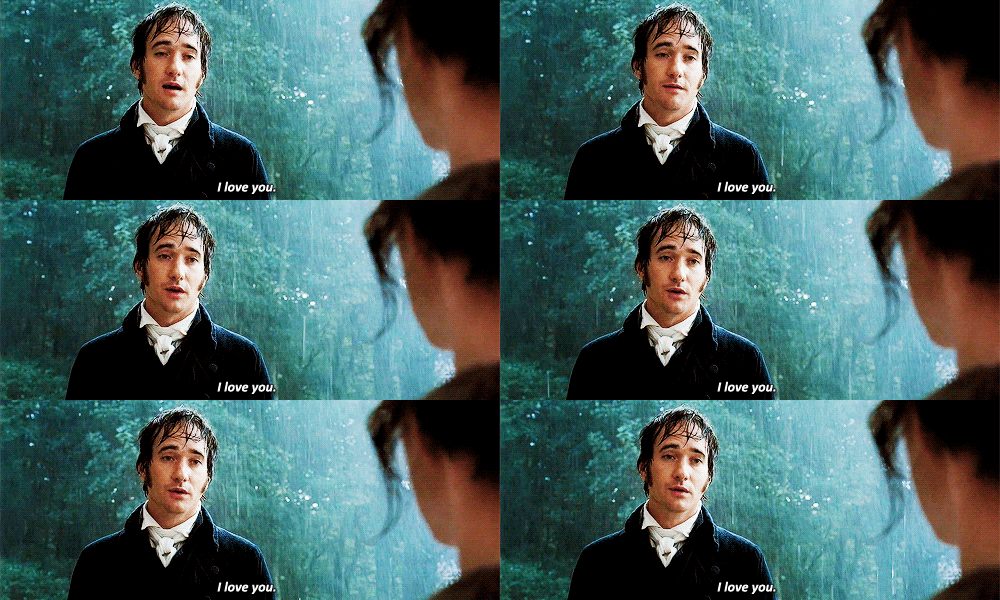
"'In vain I have struggled. It will not do. My feelings will not be repressed. You must allow me to tell you how ardently I admire and love you.' Elizabeth's astonishment was beyond expression. She stared, coloured, doubted, and was silent. This he considered sufficient encouragement, and the avowal of all that he felt and had long felt for her, immediately followed. He spoke well, but there were feelings besides those of the heart to be detailed, and he was not more eloquent on the subject of tenderness than of pride. He sensed her inferiority--of its being a degradation--of the family obstacles which judgement had always opposed to inclination, were dwelt on with a warmth which seemed due to the consequence he was wounding, but was very unlikely to recommend his suit." (131)
Mr. Darcy's suddenness here of his first proposal to Elizabeth was a significant point in the novel--for the first time Mr. Darcy is setting aside his pride to admit what he really wants--it's the first sign that he is willing to better himself for her. This act of love shocks Elizabeth, and intrigues her. This is one of the moments that always stands out the most to me--and I'm intrigued, especially by the male members of the class, what everyone thinks of this moment? Was he overstepping? Was it too much? Was this a sign of sincerity or his first sign of maturity? Because for me, this novel was filled with a lot of romantic gestures that made my heart swell, and this was really the first one of them. I love that both Elizabeth and Mr. Darcy bettered themselves for one another!!
Tuesday, March 24, 2020
I Did It!

Eight hours and 23 minutes later, I finished Pride and Prejudice for the first time. I'm not going to sugar coat this: it was a struggle. I should note that my favorite character in the book was Mr. Bennett! What voice, what humor, what relief! Immediately after reading the book, I turned to the back of my edition to see what other authors had to say about her, specifically, the comments of Mark Twain (my favorite author). Twain states, "Whenever I take up "Pride and Prejudice" or "Sense and Sensibility," I feel like a barkeeper entering the Kingdom of Heaven. . . She makes me detest all her people, without reserve. Is that her intention? It is not believable. Then is it her purpose to make the reader detest her people up to the middle of the book and like them in the rest of the chapters? That could be. That would be high art. It would be worth while, too. Some day I will examine the other end of her books and see." Leave it to Mark Twain to sum up my feelings about this book. He crystalized my thoughts eloquently! I made it through the book, and I'm willing to have a discussion of her book. I will also accept that there are MILLIONS of people who adore these books. I'll be the last person to throw a stone at other people and their tastes. We all have our faults, right? I mean, I adore Disney movies.
Tuesday, March 17, 2020
The Pain of Pride and Prejudice
So this was my first time reading Pride and Prejudice and I have to admit I would have picked another title. To keep with the alliteration I would have definitely used the word pain in the title, because it was absolutely painful for me to read. Admittedly I ended up reading the entirety of the Wikipedia page and watching the 2005 version of the novel acted out because I struggled so much to follow the text. I think we are supposed to be happy that in the end Elizabeth follows her "heart" and marries when she really knows she loves "Mr Darcy," but the journey there just left me with so many angry emotions. First off, how shallow is the entire society, but especially her mother. Clearly Mr Collins was a complete dweeb, yet she is angry that her daughter refuses her random proposal. Its as if happiness is not considered at all. Yet the takeaway is supposed to be follow your heart to said happiness? I might buy that if the entire story was not filling with having economics and class dictate relationships. It is constantly a question of whether or not the families are rich enough to marry, or if the mans estate is enough to provide for daughter A, or daughter B. Not to mention, how cliche is it that the random guy with huge wealth and perfect qualities shows up, only to have the friend with more wealth, but if an onion and needs to have his layers opened up. Then there is the fact that Mr. Darcy is really using his wealth and power to make all of these "good things" happen. I have always been rather triggered by the idea of class and wealth as a status symbol and a way to keep others down. I guess that has to do with my lower middle class upbringing. Oh well, carrying my bias with me admittedly. However something that struck my nerve was how simply these characters fall in love. I guess I have never been as admirable, or rich, or Mr Darcy or Bingley, but still I have never witnessed this quote unquote instant love then proposal that just took place in this society. I know we cannot judge a historical society through a modern lens, thus I am simply wondering, what value should I take from this story? I thought it was that we are supposed to be happy that in the end they follow their hearts and live happily ever after, but everything before that was so shallow and influenced by all these other factors.
I guess my one appreciation for this story is for Elizabeth and how rouge she is. I loved her willingness to stick it to societal norms and not settle. Not to mention telling off people of authority was quite great. I have always considered myself and evaluator. I was hear about a rule, policy etc and then decide if it made sense. If it did I would follow it, if not, I probably would not care about it. So it makes sense that I would like Elizabeth as she is willing to go against the grain and trust herself. Good for her.
One final thought, I'm glad they cast Mr Bingley as a red head in the movie. Too often we are the strange side kick like Ron Weasley rather than the admirable character. Granted he is a bit of a side kick here, but at least he is admirable....And nothing against Ron, He is the Man.
I guess my one appreciation for this story is for Elizabeth and how rouge she is. I loved her willingness to stick it to societal norms and not settle. Not to mention telling off people of authority was quite great. I have always considered myself and evaluator. I was hear about a rule, policy etc and then decide if it made sense. If it did I would follow it, if not, I probably would not care about it. So it makes sense that I would like Elizabeth as she is willing to go against the grain and trust herself. Good for her.
One final thought, I'm glad they cast Mr Bingley as a red head in the movie. Too often we are the strange side kick like Ron Weasley rather than the admirable character. Granted he is a bit of a side kick here, but at least he is admirable....And nothing against Ron, He is the Man.
Tuesday, March 3, 2020
EVERYTHING is part of a class system, bummer
"A work of art has meaning and interest only for someone who possesses the cultural competence, that is, the code in which it is encoded." (499)
I'm starting to notice that so many things bring me back to "The Educated Imagination" by Northrop Frye, and because it was happening so frequently, I thought about why. I guess it's because Frye was kind of spot on. I think that his essay has a great deal to do with what we talk about in class, and thats because it contains a very valuable and universal message. We honestly don't have much, if ANY, originality. To create, we must learn, and as we've learned from Bourdieu's piece, to consume we must learn. If we did not understand the 'code' of what we are consuming, of course it would seem like nonsense. I honestly had a hard time understanding a lot of Bourdieu's essay, but I think I got the main point (?) that because we must learn to consume, and because what we learn is influenced by our social status, what we ultimately end up consuming reflects said status. So I guess if I had any questions to ask about this, it would be what is the solution to escaping this subliminal class system of culture? Do we need to make everything much more accessible? Is this even possible? And most importantly, IF it's possible, why has it not been accomplished?

I'm starting to notice that so many things bring me back to "The Educated Imagination" by Northrop Frye, and because it was happening so frequently, I thought about why. I guess it's because Frye was kind of spot on. I think that his essay has a great deal to do with what we talk about in class, and thats because it contains a very valuable and universal message. We honestly don't have much, if ANY, originality. To create, we must learn, and as we've learned from Bourdieu's piece, to consume we must learn. If we did not understand the 'code' of what we are consuming, of course it would seem like nonsense. I honestly had a hard time understanding a lot of Bourdieu's essay, but I think I got the main point (?) that because we must learn to consume, and because what we learn is influenced by our social status, what we ultimately end up consuming reflects said status. So I guess if I had any questions to ask about this, it would be what is the solution to escaping this subliminal class system of culture? Do we need to make everything much more accessible? Is this even possible? And most importantly, IF it's possible, why has it not been accomplished?

Subscribe to:
Posts (Atom)