Thursday, April 30, 2020

Grimm's Fairytales Reimagined-Female Empowerment

Original Text: Grimm’s Fairy tales

I thought it would be interesting to take the tales of Snow White(Snowdrop), Cinderella, and Sleeping Beauty(Briar Rose) from Grimm’s Fairy tales and recreate them into a video game.  What I have noticed is that many adaptations of these classic tales such as Disney’s versions and some modern versions such as A Cinderella Story(2004), Once Upon a Time(2011-2018), and Snow White and the Huntsman(2012) all possess some of the same elements or what I would call an adapted version of the “hero’s journey” by Joseph Campbell.  Cinderella’s call to adventure comes in the form of wanting to go to the ball/festival and being guided by her fairy godmother or spirit of her dead mother in the original tale.  While with Snow White, it is the threat of her evil stepmother wanting her dead.  In Sleeping Beauty, it is the lure of the evil fairy’s curse that is triggered on her fifteenth birthday.  All these women or girls go through a version of the hero’s journey, but ultimately they do not complete the process.  It takes a man or prince in most of their cases to save them from their fates.  Especially with the me too movement and the overall movement for women’s rights that a video game geared towards women would be a good idea to create a modern adaption of these fairytales.  It seems that a lot of video games out there are geared towards a male dominated audience, I know there are some role playing/interactive apps with a female protagonist. 

Proposed Title: Twisted Fairytales  


Plot Idea:  I have a general idea for the plot.  I want the video game to give back a sense of power and individuality to these princesses by allowing them to go on their own adventures.  Perhaps each character would be playable and their story would have multiple levels to pass before they could “win” or get their happy ending.  In the case of Snow White and Sleeping Beauty, up to the point where they fell under their respective spells should be the backstory.  The game starts when they are asleep; it is in their dreams that they have to work to free themselves from the spell.  The prince could still exist but they might first encounter him in the dream world.  Cinderella could be in an alternative version of her world when the fairy godmother casts her spell.  In all their stories, the wicked stepmothers and fairy are trying to take over the kingdoms.  It is only in defeating them in the dreamworlds that they can be defeated when the spell breaks.        


Image Source: https://www.pinterest.com/pin/373376625353832927/

Keep the name, it's just too good!

Original text: The Great Gatsby

Although I know that The Great Gatsby had an adaptation come out not too long ago (in 2013 directed by Baz Luhrmann, starring Leonardo Dicaprio), and had a quite iconic adaptation come out only a number of decades ago (in 1974 starring Robert Redford), neither of these adaptations did the coveted "great American novel" justice. For some reason when people have gone to adapt The Great Gatsby, they have focused too much on the distracting love story between Jay Gatsby and Daisy Buchanan. While this adds a nice amount of fluff to the story and might sell to some viewers, what makes this novel great, and what would make it a particularly relevant adaptation of a film to come out now is its themes on the American Dream, gender relations, and class inequality. These themes are what make this novel intriguing, and done right, would make a wonderful film.

While debating the ideas of this adaption, I wondered if I should change the time of when it takes place. The Great Gatsby *is* the essence of America in the 1920s--lavish, excessive, and glamourous. However, as much as many traditionalists would possibly hate this idea, we are in the 20s yet again! Set this story in modern times, to make a stronger argument on how this novel's themes are still largely relevant. Plot-wise I think this story should largely follow the original novel (which focuses less on the love story than the films!) with modern alterations where necessary, of course. Put the financial struggles in modern settings to show that we still largely have the class struggle now as what was portrayed in the original novel.

The character of Jay Gatsby is quite an iconic one and maybe shouldn't be messed with since I'd likely ruffle so many people's feathers by modernizing the adaptation. Gatsby as a character would largely remain much of the same, while the other characters would have a similar essence with slight modern twists:

Daisy Buchanan is still married to a loaf and stuck in an unhappy marriage, but she does have a job to give her other satisfaction in life.
Nick Carraway is still largely naïve and optimistic at the beginning of the film, only to be slowly lost as he witnesses greed and hardship lose his faith in others--except maybe now he has more of a backbone and doesn't flirt with his cousin!
Tom Buchanan still sucks. He will always just be a womanizing control freak.

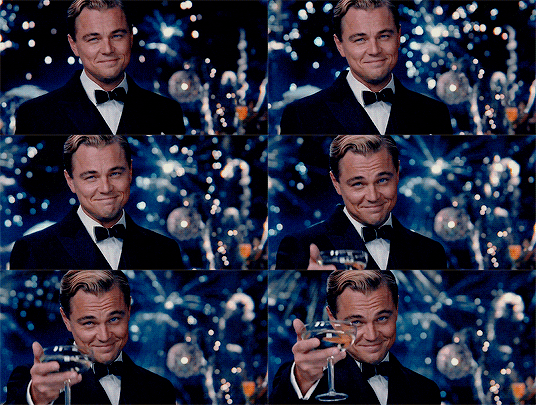
Leo was perfect casting for Gatsby... I'll give Baz Luhrmann that and that alone.


Final Blog Post: Coming through the Rye

Remix and Crossover by Kelsey Ritner and Payton Mills

Original Texts: Catcher in the Rye by J.D. Salinger, Apocalypse Now (1979) directed by Frances Ford Coppola, and The Heart of Darkness by Joseph Conrad
Remix name: Coming through the Rye
Genre: Movie
Setting: Starts out in approximately 1977 on the Hawaiian islands. Jumps back in time to 1965 and the start of the Vietnam War.

Basic plot overview: Holden Caulfield has been in and out of school since being kicked out of Pencey Prep. He barely graduates high school, but somehow manages, only to flounder through a year of college before dropping out. Since then, he has worked odd jobs and been estranged from his family. After being forced to reunite with them--and face his demons--at his sister Phoebe's wedding, Holden decides it's finally time to change his life. The outbreak of war between the States and Vietnam provides him an easy fix--Holden enlists despite his slightly older age. The "Old Guy" throughout basic training and eventual deployment, Holden is forced to grow up and provide support for the younger men in his company. The story will alternate between the present (1977) where Holden has developed into an alcoholic, his time at war, and flashbacks to Salinger's original story. The intermix of these scenes will highlight how PTSD affected not only Holden, but an entire generation. 
Apocalypse Now (1979) - Rotten TomatoesAmazon.com: The Catcher in the Rye (9787543321724): J.D. Salinger ...

TV miniseries: the Island of Dr. Moreau

Beastmen from 1977's film version
For those unfamiliar with the original, The Island of Dr. Moreau was written by H.G Wells in 1896 about a man who winds up stranded on an island inhabited by the eponymous Dr. Moreau and his creations; a collection of "beastmen" he made by vivisecting and surgically rearranging normal animals into human shape, which somehow (in addition to causing incredibly pain but not killing them) gave them human-like intelligence, although they gradual regress. It is sometimes cited as the first use of the sci-fi concept of "uplift" (making animals more human-like/sapient through induced changes). The novel has been adapted for the screen several times.
In addition to the novel's existing themes of cruelty, playing with nature, and what it means to be human, I would use a TV mini-series to examine a very pertinant modern concept; scientific ignorance/denial. The novel was written before genetics was well-understood (hence Moreau's surgical transformations), but a modern setting would allow a new angle; an ignorant and arrogant denialist who thinks his own beliefs about the way something works supersede all scientific evidence, playing god in his house of pain, and the suffering he inflicts on everyone through his ignorance. 

The People of Paper HBO Miniseries


I think that Salvador Plascencia’s The People of Paper could be really interesting if remixed into a miniseries.  The novel uses magical realism and unique text layouts, often offering perspective from multiple characters in different columns on the same page.  The story revolves around a small town of migrant farmers in Southern California.  The protagonist of the story, Federico de la Fe, begins to wage an impossible war against Saturn, who readers later find out is the real-life author of the book.  As the story progresses, Federico, his daughter, some of the townspeople, and even Saturn continually break the fourth wall and ultimately call into question their very existence as plot devices.


Although the novel relies heavily on visual aspects of the text, these could translate to the screen in interesting ways.  For example, characters in the novel who learn to maintain their privacy by blocking out text with black squares could, in the miniseries, learn to put themselves on mute, or scramble the audio of scenes they are in.  Where the fourth wall is broken, the series could use movies like The Truman Show or Cabin in the Woods as a model.  I feel that this would be better remixed as a miniseries than a movie for a few reasons.  First, there’s quite a bit that needs to happen; probably too much to squeeze into the length of a film.  Throughout the book, we also meet several characters who appear for a few pages and are never seen again.  These one-off characters, a baby who can see the future, an “origami surgeon,” and a woman made of literal paper, although they don’t necessarily add to the story itself, are important in helping build the universe, and wouldn’t be allowed their time to shine if presented in a movie. 

A Road trip Movie!

Outrageous! Raise Your Glass in Honor of Lionel Richie – If My ...

I'm a huge fan of journey films and stories.  From Travels with Charley to Huckleberry Finn, the one fully realized creative moment in American literature is the genre of journey stories in defining American culture!  Think of how many films deal with a journey:  Little Miss Sunshine, Apocalypse Now, Easy Rider, etc.  

My proposal is for a Hollywood Movie Musical about a dysfunctional family from Chicago traveling to the Hollywood Bowl so the father and mother can go to the closing night of a Lionel Richie concert.  The trip would be filled with the music of Lionel Richie!  From the Commodores to his solo work, all of the "hits" and "LP cuts" would be used to help tell a story of discovery for both the main characters' human spirit AND a look at the America of today!  Yes, I know that I set it on the mythical Route 66. . . . 

The family would be comprised of two middle-age parents (Mom and Dad), their gay 16-year-old son, and their 13-year-old daughter.  The parents are upper-middle-class, but their marriage seems dead, their son has yet to come out to his parents, but his younger sister knows.  The son is quiet but devilishly snarky, the daughter is a bubble of energy.  Like all road trip/journey adventures, each stop reveals a portion of America, and thus, a portion of themselves, all with the music of Lionel Richie to help propel the story.  The entire movie would end with the family at the concert singing and dancing to "Dancing on the Ceiling".

Along the way we will be treated to our main characters and different people they meet singing such classics as:
  • Hello
  • Can't Slow Down
  • Truly
  • You Are
  • All Night Long (could open the film)
  • Serves You Right
  • Brick House
  • Ballerina Girl
  • Wandering Stranger (The son's big song halfway through the film)
  • Easy (This song would be the climax of the film with the entire family singing in the car)
  • Dancing on the Ceiling (The final, closing BIG number)
If nothing else, start listening to the songs.  I think you'll see how easily they all work!

Versions of Verse

My idea was inspired by watching The Ballad of Buster Scruggs over the weekend. The whole movie is fantastic, but I especially loved the last vignette and the parallels to Emily Dickinson's "Because I could not stop for Death." I got to thinking that it would be a cool television show idea to have each episode of the show centered on a famous poem. The episode would be broken into separate vignettes (maybe 4-5 per show), and each vignette would be a different director's "take" on that poem. (The show could feature one or two amateur directors as well as more well-known directors.)

I realize this is a super-geeky idea, but I think there are some interesting parallels between film vignettes and poetry. Both tend to depend on brevity, and both depend on both structure and content to make meaning. Here are a few episode ideas:

Episode One: "The Road Not Taken" by Robert Frost
Directors: Sophia Coppola, Woody Allen, Spike Lee

Episode Two: "Annabel Lee" by Edgar Allen Poe
Directors: Clint Eastwood, Tim Burton, James Cameron

I mean, these directors would DEFINITELY want to do this television show, right? 😂

"Whether or not he heard, the coachman did not slow."
Coen, Ethan and Joel Coen, directors. The Ballad of Buster Scruggs. Netflix, November 2018.